Response to “Things I’m Struggling with as a Musician/Human Being”

My younger brother has been thinking about “being an artist / human / creator in this modern age,” so he wrote about five of his current questions, worries, and concerns, and then answered them. This is a response to that post, “Things I’m Struggling with as a Musician/Human Being,” from his blog I Will Write About Music Here.


Hello, Luke.

As you know, I am not a musician, but still feel as I can relate to these questions. Perhaps my extra ~3 years on this Earth can offer a slightly different perspective, so here are some of my thoughts about each of your questions and responses.


1. Do people have time for art anymore? Is it relevant?

Yes, it’s definitely very relevant, and it’s no surprise we’re both on the same page here.

You had asked what is art’s place within all of the world’s very real problems (poverty, sickness, genocide, war, global warming, political divisiveness, etc.), and I’d say that art is a huge tool for making progress in those issues.

Advocacy is a big way art can help—doing a photography exhibit, cartoon, or concert to raise awareness or money for a cause. (In writing this, I discovered there’s a group called Artists Striving To End Poverty, which must just be the tip of the iceberg.)

Art itself can also change the world through individuals and communities, as shown in JR’s “Use art to turn the world inside out” wish (and results) at TED.

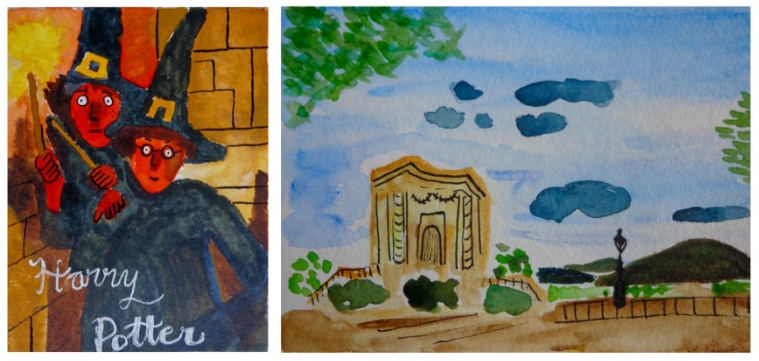
A group of Syrian refugees are using art to preserve their culture by recreating historical landmarks. Ahmad Hariri, who plays a big part in the project, says (emphasis mine), “It felt like a good way to get the message out, because art is a language that doesn’t need to be translated.”

And especially with war and any other less-than-desirable situations, people have used (and always will use) art to escape. Think of all the songs sung by African American slaves, for example.

Jumping back to the first half of this question—do people have time for art—I want to note that “people” spans a huge range of lifestyles and cultures. Some of your American peers may not appear to have time, but that’s just a tiny fraction of the people on this planet.

During my year in France, I got the impression that it was quite common to go to an art gallery or museum on the weekends, which Damien and I did every couple of weeks (even though he is very much a mechanical guy); art can be appreciated by all.


2. I feel uneasy about self-promotion. To the outsider looking in, I must look like one helluva self-absorbed guy.

I struggle with this one, too, in sharing things I write or sell (-cough- Korean food guide I spent two years writing and of which I have yet to sell one single copy -cough-). But realize that people who follow you on Twitter or who like your Facebook page, for example, have chosen to do so. They want to see your face, watch you play, and hear your thoughts. So no need to hesitate posting about yourself there.

Where it can feel self-absorbed is going outside of those circles to connect with others. But as you’ve said, this is necessary in order to get your art into the world. If people don’t care or aren’t interested, they don’t have to click/watch/read. They choose. And then everyone continues on with their lives, and no harm is done.

But when your work reaches someone who does care, it could very well have an effect on their life (and yours). There are likely a ton of people who would like to see your face, watch you play, and hear your thoughts—for a variety of reasons—but they haven’t met you yet. So self-promotion increases you chances of “discovering” each other.

Although innate for you and me, I don’t think this feels self-absorbed for everyone. I think the fact that it does for you shows how aware you are of others in the world.

I feel like I’ve probably recommended this to you already (and maybe you’ve already read it), but I enjoyed Austin Kleon’s “Show Your Work,” which had worthwhile ideas about sharing one’s creations.


3. Sometimes I find myself falling into the trap of equating my level of musical performance with my self-worth.

You know what, while I can relate to this one (in a non-musical sense), I actually don’t think everyone can. I’ve met people who were terrible at their jobs, but they absolutely didn’t care—for a variety of reasons. A job for some is a completely separate entity, and their job performance is only that. Not all cultures are so “success”-driven like in America, but I’m glad you’re wary of that darn s-word.

I really like your idea of measuring “success” with growth-centered markers (surprise, surprise, after my obsession this year with Carol Dweck and the growth mindset). Or, as you wisely recently told me, you could measure achievement by how close you are to being “your truest you.”

And I admire your large step back into the fact that we are all humans.* As time goes on, I only see more and more examples of how complex (and long! yet short) a person’s life can be. Someone’s website or video is an itsy bitsy item, but a human being—their emotions, past, desires, relationships, society, daily struggles, passions, body language, genetics, creations, community, etc.—that’s a full-blown 4D experience. I’m simplifying this, but someone might be able to give a kick-ass piano performance in front of a camera, yet could be a total asshole. We cannot be defined by one thing.

(*And if you’d like to really freak out your mind, take an even larger step back and see that us complex human beings are minuscule specks of dust in this ever-expanding universe.)


4. Is music my true “calling”?

A few questions to start: Does each human even have a true calling? How do we know? And would “true” mean just one?

I was so excited to learn, upon reading Julia Child’s awesome book “My Life in France,” that she first went to France at the age of 36. Her entire love affair with French cuisine and cooking (including all the learning (starting at zero), experimenting, cook-book writing, and TV hosting) happened after that point. Although I realize it’s silly to use 36 as an arbitrary age comparison, it’s still cool to think: “I can keep farting around for nine more years, and my greatest life pleasure might still be ahead of me!”

As far as following paths goes, I think this Ralph Waldo Emerson quote speaks for itself:

“Do not go where the path may lead, go instead where there is no path and leave a trail.”

Later on you’ll be able to connect the dots backwards and see the path you made.


5. I feel stuck, musically. I feel like I’m playing the same things again and again.

Good idea to force yourself into the uncomfortable by forbidding a certain lick or style! You know, I’ve read that Dr. Seuss was bet by his publisher that he couldn’t write a book using only 50 different words. The result? “Green Eggs and Ham.” By imposing limits, you can force yourself to be creative.

Exposing yourself to new things can help get your creative juices flowing, too. That can be as simple as walking a new route to somewhere you go often, reading a book or article outside of your preferred genre, socializing with people in different fields from you, etc. Remember that you have (to an extent) control over your input: what you see and hear each day. By controlling the input—and then giving yourself space for the subconscious to make connections—you’ll get unstuck.

I’m not sure how much you’d be able to apply the ideas when composing, but I really liked Michael Michalko’s “Thinkertoys: A Handbook of Creative-Thinking Techniques.”

So to conclude as you did, none of us have it figured out. And I don’t think we’ll ever feel as if we have it “figured out” (let’s ask Grandma?). Gregorio (age 50) just mentioned the other day that if he couldn’t see himself in the mirror, he feels—in his mind—the same as he’s always been.

Thanks so much for sharing your thoughts with the internet world—for beginning this discussion. It’s never easy to be raw, let alone with an audience, but the audience always appreciates and benefits from it (as does the one who shares their inner thoughts, right?).

Actually, today’s “Daily Clue” email from Amber Rae ended with:

“The vivid detail at which you share the truth that stirs in your soul will move all the people it’s intended to touch. The aim is not to receive mass approval or have everyone connect with your work. It is to reach those who experience goosebumps when they come into your orbit because the realness at which you create grabs them and pulls them close. Be true to yourself, and the work you know you must create, and you will experience the profound joy of honoring yourself and your creative vision.

And as Neil Gaiman reminds us: If you’re doing it right, you will feel like you’re revealing too much of yourself.”

So here’s to many more decades of questioning, reflecting, revealing ourselves and sharing as we both continue on this journey of growth.

Love,
Rebecca
The Joy of Being an Adult Beginner

Watercolors

At our weekly Couchsurfing event on Tuesday, I mentioned that I’d gone to Parc du Peyrou the previous day to read and paint.

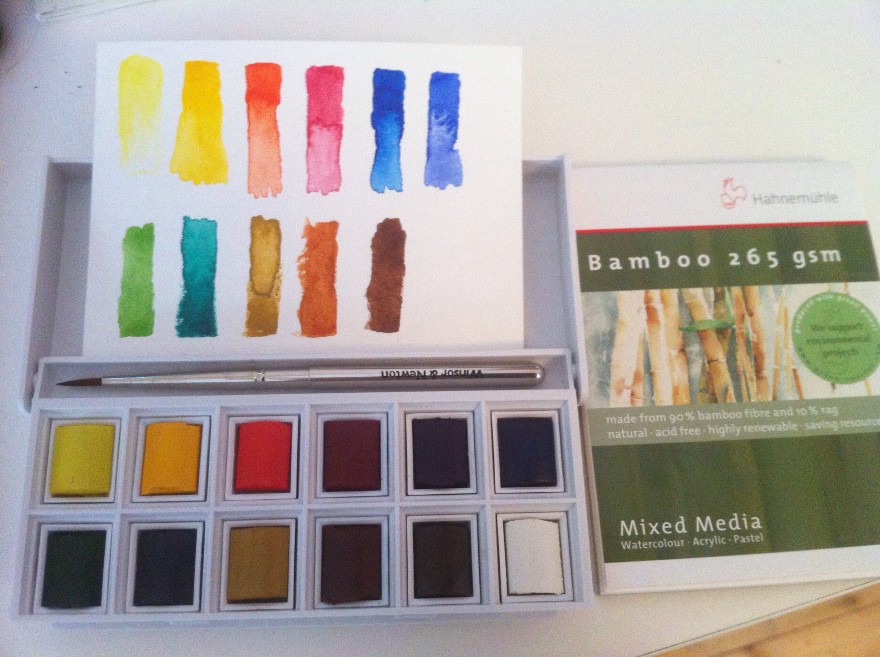
“Watercolors,” I clarified, “I just bought them a few weeks ago.”

“Are you good?” the Polish girl immediately asked me.

“No! I just started — that would be crazy.”

After a few startled seconds, I saw the realization come to her face that my answer made sense logically.

Most of us forget this, though — that beginners start at zero, and that adults can be beginners. There seems to be this belief in the adult world that if you do something, it must mean you’re good. Or the contrary: If you’re not good, you can’t say you do something.

I see this again and again as I interact with language learners. “My English is bad” or “I can’t speak very well,” they’ll explain.

Hold up!, I tell them. You’re at some point along a very lengthy journey, and languages are seriously complex creatures. You may not be able to speak very well today, just like all learners who were once at your exact level, but you need to pass through this stage to get to the next. With repeated practice, you will improve! Every mistake or struggle is a learning opportunity.*

So whether it’s painting, speaking foreign languages, or anything in between, you can do whatever you want to do in your free time, no matter your current ability. And if you start learning a new skill, it’s completely normal and expected that you won’t be “good.”

Now you can certainly become “good” over time, since improvement is a natural result of repeated practice. But during the journey, the question to ask — both yourself and others — isn’t “Are you good at it?” but rather “Do you enjoy it?”

For me, painting with watercolors has been so fun! At this point (which is only four tiny paintings in), I don’t care what my creations look like. They’re a means for me to explore, to learn, to relax, and to get comfortable with these new materials. I’m thoroughly enjoying the process.

First Watercolors

My takeaway from this reflection? If you’re curious to learn something new, go ahead and start where you are now. Be proud to be a beginner. The experience of learning and seeing yourself improve is exciting and rewarding, and these perks are unlike anything you’ll encounter when you’re already good at something. You’ll push your comfort zone the slightest bit wider, which ultimately brings about a satisfying feeling.

Don’t ignore your curiosities because of society’s pressures to be good, and try not to impose such expectations on others either. Everyone is in the middle of some journey, each which is uniquely carved and shaped by decades of situations, interactions, and feelings. We’re unfinished works of art who advance from encouragement to continue exploring, not from judgement on ability to meet absurd expectations.

And with that, I encourage you to keep on searching, experimenting, and learning!


*For those of you interested in learning a language with a growth mindset, here’s how to get started.

The Line I Wish Michelle Obama Hadn’t Said in Her Badass DNC Speech

MichelleObama

If you haven’t seen it yet, you can watch Michelle Obama’s fantastic speech here.

It’s hopeful, powerful, and evokes emotion.

I was getting chills while watching, which I can’t say is a common occurrence for me.

And then she said 10 words which made me absolutely cringe.

Ten words which made me wonder how closely my values actually aligned with hers after all.

She said:

“Because this, right now, is the greatest country on Earth.”

Noooo, Michelle! What?!

Not you, too.

Before I go any further, here’s what came immediately before that line, for context:

“So don’t let anyone ever tell you that this country isn’t great, that somehow we need to make it great again.”

I understand the point is to counter Trump, but there were so many other ways she could have done this.

But instead, she called America the greatest country on Earth.

Says who? And by what standards?

Are we looking at overall quality of life? Number of Olympic medals won? Advances in technology? The health of our citizens? Tastiest food options? Lowest unemployment rates? Quality of public education? Etc.

You know what, I don’t even want to entertain this half of it. Because criteria aside—and ignoring the fact that we’re absolutely not the “greatest” in so many categories—why are we speaking about a greatest country on the planet to begin with?

Why must there be a first place?

This isn’t a competition.

This is life: the daily struggles, the joys, the love, the grief, the curiosity, the adrenaline rush, the tears, the pride—our stories, past and present.

Why does that need to be ranked?

It doesn’t.

And it shouldn’t.

To me, “greatest country on Earth” sounds as foolish as “greatest parent on Earth.” There are tons of amazing parents on this planet. There’s no need—nor any good in—singling out one parent that’s better than all the rest.

How would that help us overcome the challenges that the world faces today?

How would that leave the world better off for the next generation?

So here’s what I say:

America is great.

And so is this planet.

So by working together with our fellow citizens of the world, we can all keep this world great—for everyone.

Cracking Humanity, One Egg at a Time

A week after the Paris attacks, November 2015


Tap tap, crack. Swoosh, plop.

I don’t know how many eggs I’ve cracked in my life, but there seems to be a common rhythm to it.

Tap it once or twice against the side of any hard surface, crack apart the two halves, and let the soft innards drop gently into the dish. Then toss the shells into the compost, garbage or sink.

Today my egg-cracking took an interesting turn of events.

I was making a chocolate cake-in-a-mug, using the same recipe my boyfriend Damien and I had followed the night before. I’m not exactly sure why I took the whole egg over to the trash can to begin with, but I did.

Just before heading there, I had a hazy, quick flashback to a moment from last night’s cake-in-a-mug-making session. When I’d picked up the first egg to crack it, he’d quickly let out an exasperated “Mais qu’est-ce que tu fais?” (Wait, what are you doing?), took the egg from me, and cracked it himself.

Damien says I was going to add it in the wrong order or something like that, but I was under the impression that he had thought my hands were too full, busy stirring the dry ingredients. Whatever the case, Damien had continued to comment about my near egg-cracking faux pas while taking over, and then stepped on our trash can’s foot pedal and tossed in the empty shell himself.

So since I was baking alone today, when it came time to crack the egg, I had a split-second, subconscious doubt that I might screw it up—as had almost happened last night (from Damien’s perspective). Thus apparently I thought that it would be a good idea to have my foot already pressed down on the trash can pedal before cracking the egg.

The whole 2-second scene went down like this:

I stepped my foot on the pedal to open the trash can lid. Since I was now in such proximity, I hit the egg twice on the side of the metal trash bin, covered by a liner, to crack it open. During that split second, my mind contemplated the cleanliness of breaking an egg on this part of a trash can, but I quickly decided what I was doing was okay—because it’s just the shell that’s making contact with the upper part of the trash bin.

I’d finished my “tap, tap,” and next always comes the crack, swish…

And just as the yolk end egg whites fell to the bottom of the trash can, I realized the foolish thing I’d done. But it was too late.

There was no way to save that egg at this point, so I tossed the shell in right after it, shaking my head at the complete idiocy I’d just committed.

I just cracked an egg straight into the garbage.

I continued to shake my head, asking myself, “Wait a minute, did you really just do that?”

And this got me thinking—why?

How could I have done something so stupid?

I chalked it up to habit. A sort of muscle memory, have you.

Tap tap, crack. Swoosh, plop.

Twenty-six years of egg cracking has ingrained that pattern in my mind.

I continued to let my thoughts wander, as if I needed this tiny, brainless event to amount to something significant. So I asked myself: What other actions are so strongly a part of me, that I would follow them through as quickly as I had cracked that egg into the trash?

Better yet, what reactions to certain cues are part of human nature?

When there is terror, do we automatically react with rage and attack, or do we arm ourselves with love and kindness?

I have seen both reactions in the past few days.

Although I’m upset and angry—feeling the depth of this loss, its barbarity, and its evil—I know through my core that war is not the answer.

War will never be the answer.

Let’s use words. We are fully capable of talking and communicating like civilized human beings of the modern world. There is certainly no shortage of communication tools, multilingual people, and technology.

It’s not as simple as translating, I know very well. That’s why the term “cross-cultural communication” exists. The more time I spend living abroad, the more examples I see of how cultures and languages really do affect a group’s perception of a concept. But smiles, love, and laughs are universal—just like human struggle, pain, loss, and grief.

So let’s also put love in the spotlight. We can use our skills, talents, and drive to create more love.

I can’t single-handedly stop ISIS from terrorizing people, but I can create more love in the world. I can make a difference. We all can.

Most of us can clearly remember a time in our lives when someone else told us “you can” or “you can’t.”

Be someone who tells others they can. More compassion all around can encourage someone to bring to life the treasures inside them—whether you know it at the time or not. It’s a ripple effect.

Include others. Create supportive communities. Smile at your cashier and ask them how their day is going. Stand up for someone getting singled out. Lend a helping hand. Teach others what you’ve learned. Share your love and compassion.

You don’t have to be the next Gandhi. But what if you unknowingly play a role in inspiring or sharing strength with “the next Gandhi”?

Every day, each of your interactions affects others’ lives—shaping their beliefs, values, and perspectives—often in ways you’ll never know.

Just as I will never know if my small egg-cracking faux pas, which eventually led to this very article, will change your actions.

But I’ll continue to share my encouragement, with the belief that we can tip the balance of all interactions in the world to weigh on the positive side.

Tap tap, crack. Swoosh, plop.

Let’s crack open the core of humanity and let the love flow.